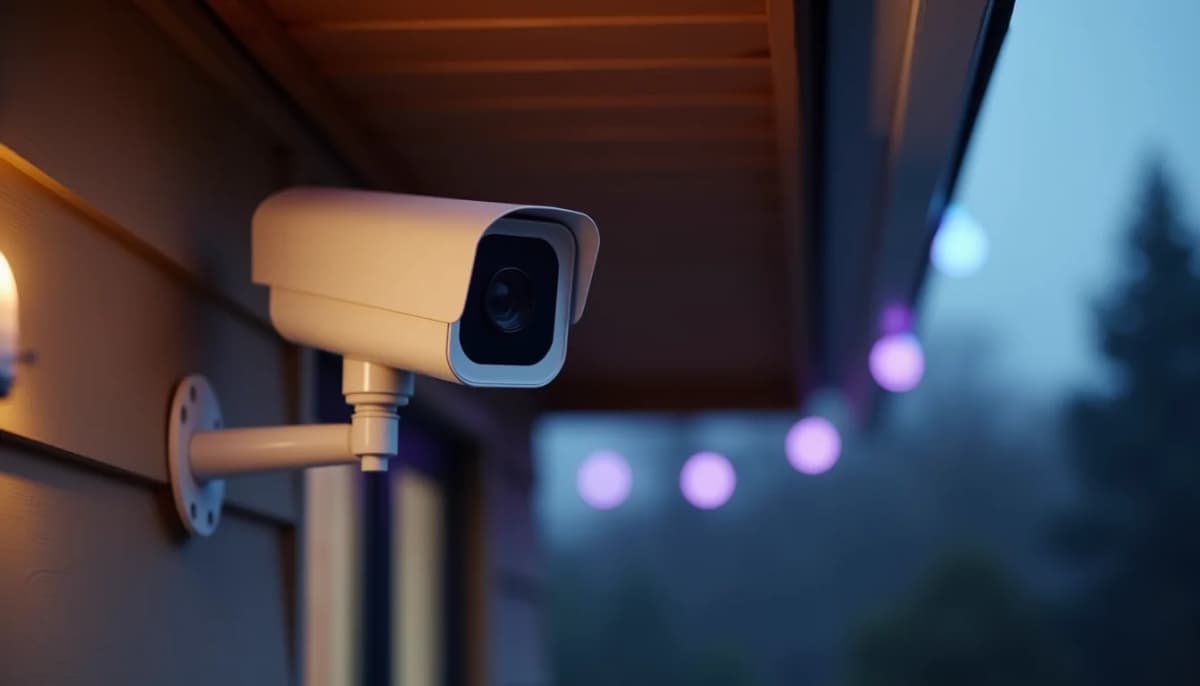
A doorbell camera covers your door, and that's it. If what you want is to see who rang and whether the box actually made it to the mat, one good wired doorbell is the whole job and you can stop reading. If you also want to know what happened to the car in the driveway or who walked down the side of the house at 11 p.m., you need a second camera — not a better doorbell.
A doorbell sits at chest height because that's where the face is. A driveway camera goes 8 to 10 feet up and angled down. You can't get both out of one box at the front door.
What a doorbell actually sees
Past about a dozen feet you stop getting a face and start getting a shape. That's why the second camera goes where people have to walk past it, not on the corner of the house.
At night a doorbell sees maybe 15 feet and then it's black. A bullet like Reolink's RLC-811A does infrared out to about 98 feet with a spotlight, so you get color instead of grey. Most of what people call us about happened after dark, and in December here that starts at 4:20 — plan the camera around night, not around the daytime view.
Where the second camera goes
For most retrofits the gaps are the same three places: the driveway, the side yard or gate, and the back door. Whichever one you cover first, don't try to cover a whole yard with it — aim at the pinch point people have to walk through, close enough that a face crosses the frame at ten or twelve feet rather than thirty.
On a recent Kirkland retrofit we put cameras on a tree in the front yard, at the side door by the shed, on the basement door, and one indoors over the dog crate, plus the doorbell — the tree and shed runs were the ones that needed exterior drops back from the panel, and all of it landed on a single 8-port PoE switch and an NVR.
Before you pick models, answer two questions, because they decide the cost more than the cameras do: where is everything terminating — closet, garage, basement — and do you have attic or crawlspace access to get there? A retrofit in a finished house lives and dies on that. If the answer is "neither, really," that's running drops through finished walls and soffits, which is a different job than dropping into an open attic.
What you don't need
You don't need Cat6a. Cameras push a few megabits.
On a Seattle job in August we ran three outdoor-rated Cat5e drops, basement and exterior, all coming back to the same spot — Cat5e is plenty for cameras. Run Cat6 for the data drops that carry your actual network traffic — inside a house it does everything Cat6a does. Cat6a only earns its cost on a single run past about 150 feet.
You don't need a separate PoE switch if you're buying a PoE NVR — the NVR powers the cameras itself. Buy the switch only if you have other PoE devices to feed, or if the recorder you picked has no PoE ports of its own, which is why the Kirkland job above needed one — that NVR has no PoE.
You don't need to replace the doorbell you already have. If it does the door well, leave it and put the money into the driveway camera.
You don't need 4K on every corner. Resolution is the cheap part — a camera pointed at the wrong distance stays useless at any resolution. Spend the effort on where it goes.
You probably don't want a battery camera on the driveway. Battery cameras go back to sleep after each alert. Someone walking in from out of frame and grabbing fast is exactly what gets missed. On the driveway I'd run a wired one.
In an older house, listen to your chime before you buy anything. If it buzzes, hums, or rings by itself, your transformer is probably too weak for a wired doorbell and it won't work right no matter which one you pick. That's usually the actual job — swapping the transformer, not the button.
If you want a second opinion on where the two cameras should go before you spend anything, we do a free overview appointment — send me a full address and I'll check availability, and you can see what we install and how it gets wired while we're walking the property.
Have questions about your project? Contact us for a free estimate.