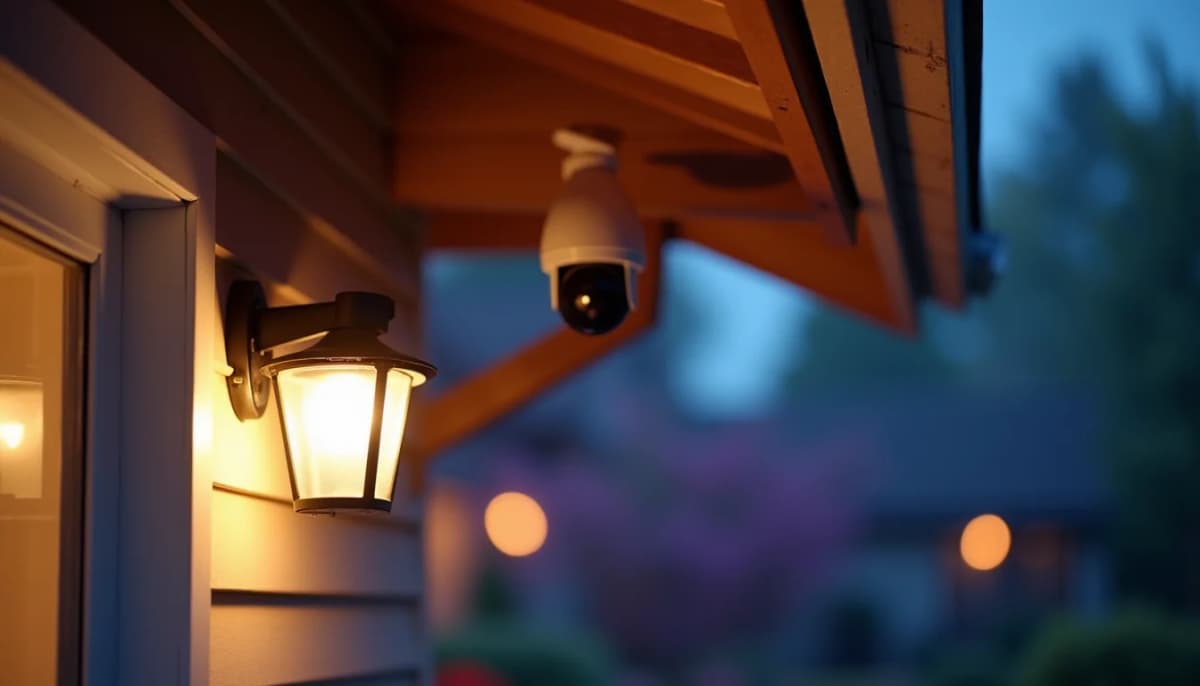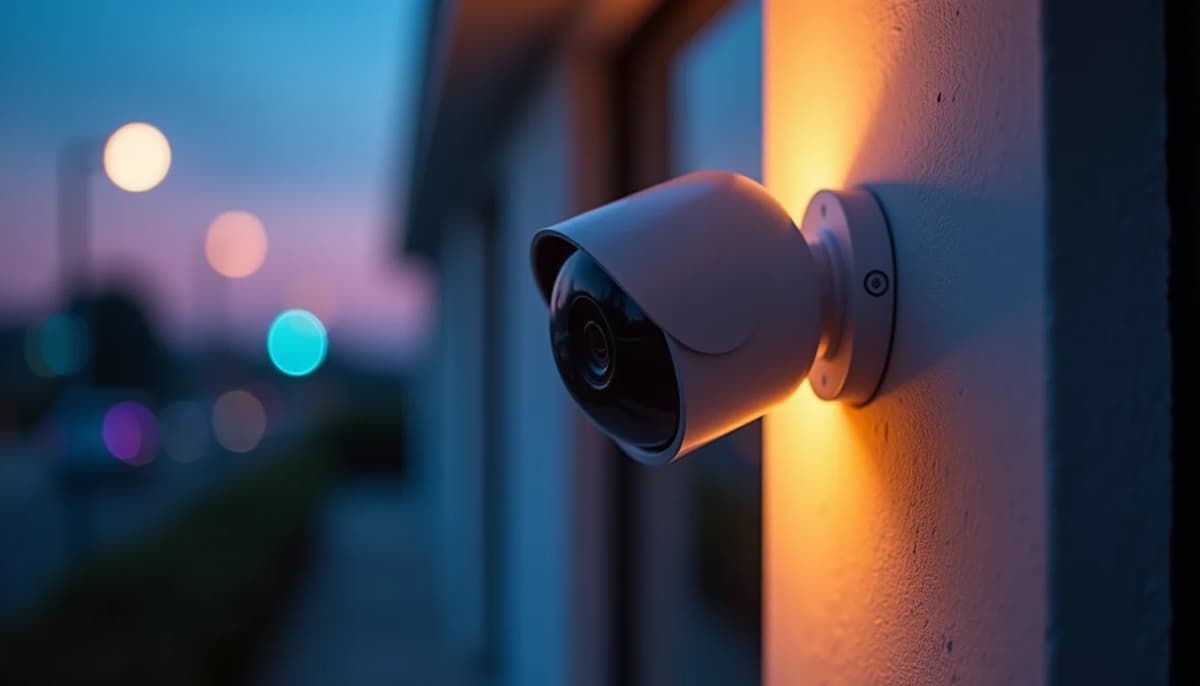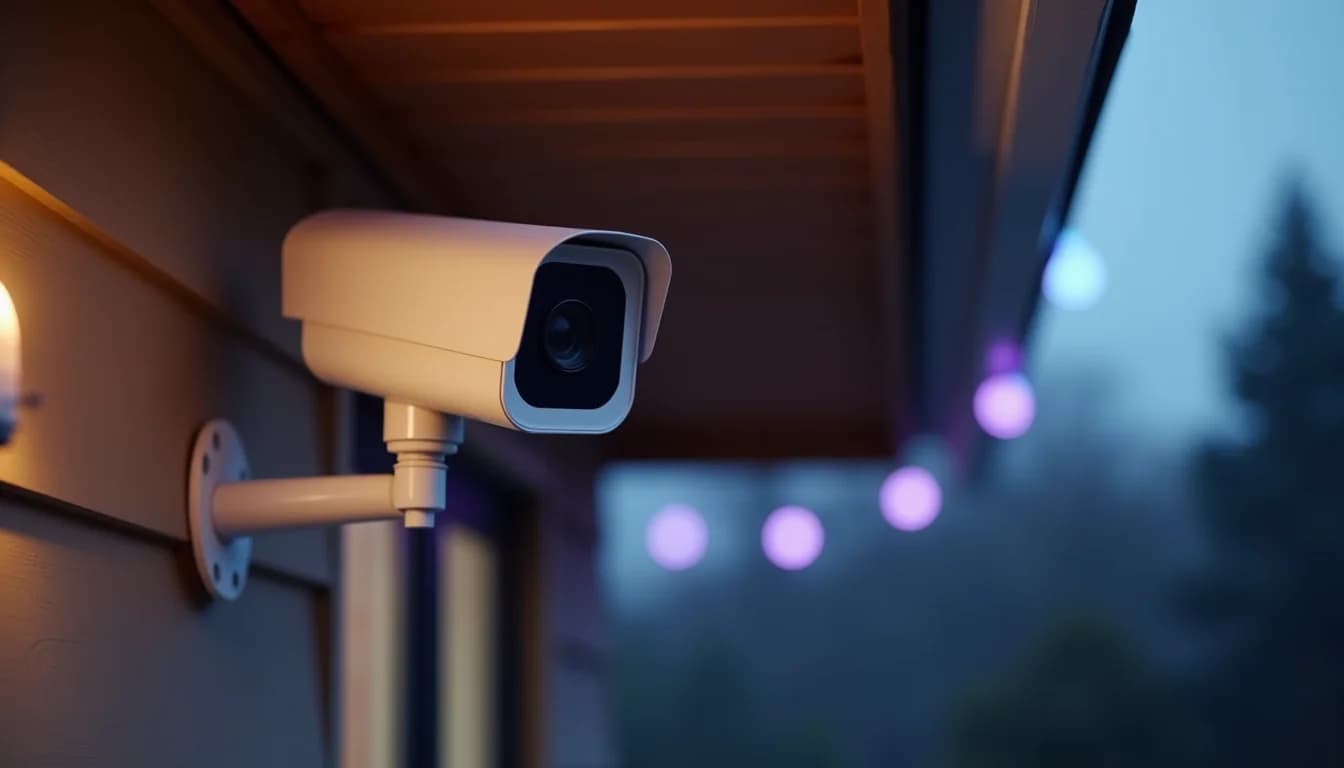
Mount it at eight to ten feet, pointed at the door, gate or driveway people actually walk through, with the lens out past the edge of the eave instead of tucked up underneath it — and keep it a foot clear of the downspout corner. That covers most of what goes wrong on a retrofit.
How high to mount, and which corner to use
Don't put it under the second-floor soffit — you'll record the tops of heads. Put a cap on that person and you have nothing. You can tell the police someone was there, and that's it.
Eight to ten feet is the range that works. We set ours at nine and a half feet, low enough that the camera is looking at a face rather than a scalp. Take the small risk of a reachable camera over the certainty of unusable footage.
Two things follow from the height. The camera won't see the ground directly under it, so if you want the package on the step in frame, that's a second camera across the porch, or a doorbell. And at that height the camera looks along the ground rather than down at it, so it needs a clear line — angle it so the walkway runs toward the lens rather than across it.
Then pick the corner for the approach, not for the elevation. When we lay out a camera system we start by drawing the paths from the sidewalk, alley and side gate to each door, and put cameras where those paths converge, each one covering the way in to the next. Somebody has to walk toward one camera to reach the other.
Before we pick the corner: is there attic access above that wall, or does the cable have to come up from the crawlspace?
Night vision: infrared glare is what ruins the picture
Infrared doesn't care that the soffit above the camera is out of frame. If a wall, eave, tree or shrub sits close to the lens, the night image washes out, because the camera's own infrared bounces off it and blinds the shot. That's one of the most common reasons a camera that looks perfect at 2 p.m. is worthless at 2 a.m.
The fixes are physical. Angle the camera down and out so nothing solid sits close to the lens. Prefer a bullet body, whose lens sits further out from the structure, over a turret pressed up against the soffit. Skip domes outdoors, the bubble hazes over at night — get the same sensor in a turret or bullet. Keep the glass clean while you're up there, because cobwebs, dust and water droplets throw infrared straight back into the lens and blur the night picture.
Seattle winters are dark most of the day, so the camera is running on infrared for most of it. An infrared problem here is a full-time problem.
Webs across the lens will wreck the night picture too. Spray a long-lasting crawling-insect product around the mount every few months. The other answer is to turn the camera's own infrared off and light the area from somewhere else — separate illuminators, or PoE LED lighting on its own run. The picture cleans up and the bugs go to the light instead of the lens. It costs another cable, so it's a choice, not a default.
Ignore the infrared range printed on the box. It tells you how far the light reaches, not how far you can recognize a face. Stand where you need to recognize a face, and put the camera there.
Rain, condensation and false alerts
The camera under the eave is not a dry camera. Wind-driven rain and condensation still reach the connections. Use the waterproof boot that came with the network connector, put any power or reset pigtails inside a weatherproof junction box, and leave a drip loop below the entry so water runs off the cable instead of following it into the housing. Keep the mount a foot clear of the downspout corner — runoff off a gutter corner will kill a camera that survives everything else.
Don't pay up for a higher weather rating. What keeps water out is the boot, the box and the drip loop.
Then budget for the alerts. Rain falling through the infrared beam reads as motion, and so do branches and shadows. Expect hundreds of junk alerts a week until the zones are tightened. Person and vehicle detection, with the detection zone drawn tight around the walkway or driveway, will help cut the noise — it won't end it on a wet night.
Audio, approvals and the cable path
Washington is an all-party-consent state for private conversations, so a live microphone over a porch is a real exposure. Turn audio off, or put a sign up.
If you're in a historic district, a camera on the street side needs approval — check before we schedule.
The cameras want a recorder and a switch that can feed power over the network cable, which makes this as much a home network job as a camera job, and the structured wiring path is what actually decides your placement. In an older house with enclosed soffits and plaster walls, the cable route is usually what settles the argument about where a camera goes. You don't need to spend up on the kit — the placement and the cable path are what make it usable.
Have questions about your project? Contact us for a free estimate.