PoE lighting is worth it when the walls are open or there's an attic over the rooms you want to do. In a finished house without that access, smart lighting on your regular wiring, or a home automation system, gets you most of the same dimming, scenes and phone control with a lot less opening up. PoE lighting itself means each light gets its power and its control over one network cable, run back to a switch instead of to a breaker.
PoE lighting in a home: where it fits and where it doesn't
New construction or a major remodel is where PoE lighting makes the most sense. With the walls and ceilings open, we design the fixture layout with you and run cable to every fixture or driver location. Then we come back later to install the fixtures, switches and controller and do the programming. That's the easy version. More on how we approach it is on our PoE LED lighting page.
In a finished house, it depends on access. If there's an attic above the rooms you want to do, or a ceiling you can get into, a retrofit is doable. If it's a main floor with a finished second story on top, every fixture means fishing cable through a closed ceiling. That's the same problem as any wiring in an older Seattle house.
Quick self-check: go up in the attic and see if you can reach the area above the rooms you care about. If you can, you're in good shape. If the rooms you want are under finished floors, those are the ones to think twice about.
You also don't have to do the whole house. A kitchen and family room under an attic can be PoE, and the rest of the house can stay on regular wiring with smart switches. That can be the more sensible split.
For offices it's a slightly different conversation, and our commercial page covers that work.
What PoE lighting is
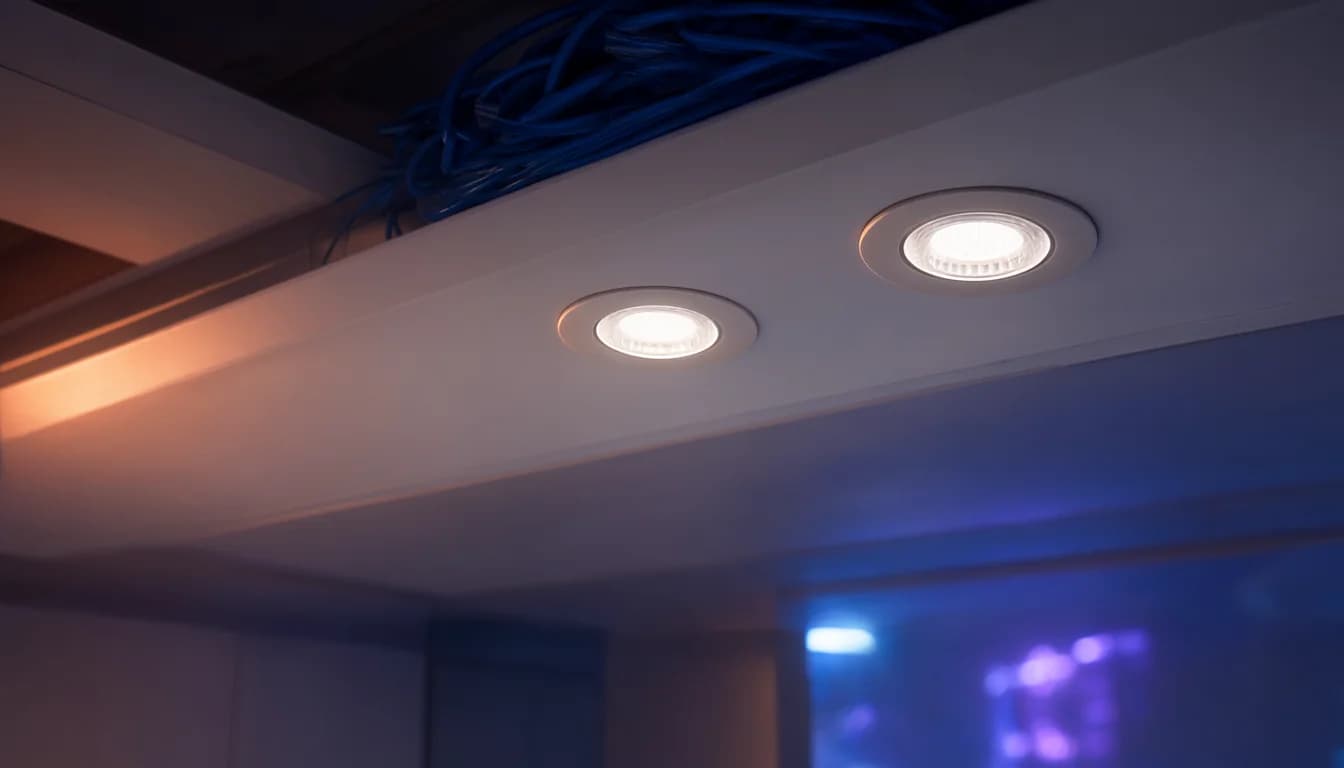
Each light is a hardwired PoE fixture. It's not a smart bulb, and it's not a regular light with a smart switch. The fixture connects with Cat6 back to a PoE switch in your network closet or equipment room, and that switch sends low-voltage DC power down the same cable that carries the control. A network cable run tops out around 330 feet, so in a big house the switch has to live somewhere central to the rooms it powers.
Not every fixture needs its own cable all the way back. Some fixtures get their own run, and some share a small driver that feeds a few of them. That's part of the layout we design with you before any cable goes in.
The fixtures draw very little. Most PoE LED fixtures are in the 7 to 18 watt range, which is why a network cable can power them at all.
We program the scenes, schedules, dimming and color tuning during the install. And because everything is powered from the switch, put the switch on a battery backup and the lights can stay on through a short outage. With regular lighting that's much harder to do.
The trade-offs
What you give up:
- You pick from PoE fixtures only. Regular screw-in bulbs don't work, and most decorative fixtures aren't made in PoE. Chandeliers and pendants you love will likely stay on normal wiring. If you already have a ceiling full of fixtures you like, that's a reason to keep those rooms as they are.
- The fixtures and the app all come from one maker (we install PoEWit). Grouping and control live in that maker's software, so if a fixture fails years from now, you want a matching one. Buy a few spares up front.
- The switch is now your light switch. If the network switch reboots, for a firmware update or anything else, the lights can go off until it comes back up on many switches. Some switches keep power to the lights through a reboot, so it's worth asking which kind you're getting.
- You still need an electrician. The cable to each light is low-voltage, but the switch itself needs a dedicated power source, and our licensed electricians install it. The money doesn't disappear either. Some of what you'd normally spend on electrical wiring shifts to cable and network gear.
None of that is a reason to skip it if your house fits. It's just what you're signing up for, and it's better to hear it before the layout than after.
What to ask on a walkthrough
On a walkthrough, the things that matter are the rooms you want to do, the attic or crawlspace above or below them, and where your network closet is or could be. Questions worth asking, whether it's us or anyone else:
- Which rooms are worth doing in PoE, and which should stay on regular wiring?
- How many PoE switches will this take, and where do they live?
- Does the switch keep the lights on while it updates?
- What goes on a battery backup, and roughly how long will the lights stay on?
The written estimate comes from the lighting layout. The biggest thing that moves the number is whether the walls are open or closed. After that it's fixture count and type, how many switches, how long the runs are, and any integration with a system you already have. The cabling side of the job is covered under wiring services.
Have questions about your project? Contact us for a free estimate.