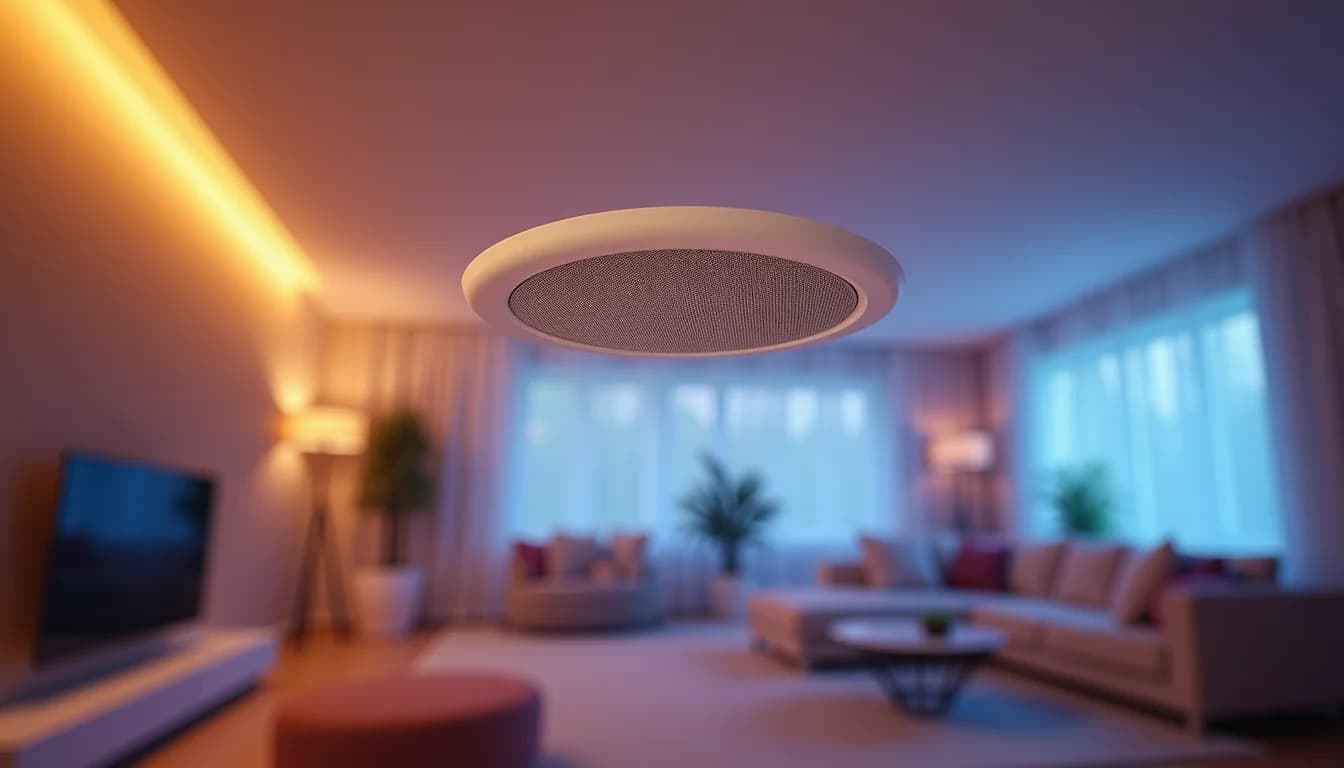
If you can get into the attic or crawlspace over the rooms you want music in, wire in-ceiling speakers there; if a room has a finished floor above it, use a plug-in wireless speaker there or plan for wall cuts. With access, the speaker wire comes in from the attic or from below, and the speaker cutout itself is the opening. So the first question is a practical one: can you get over or under each room on your list?
Before you buy anything, check what you already have. If a room already has a receiver or stereo you like, you don't need new speakers there at all. A Sonos Port adds streaming to it and joins it to the rest of the house.
Attic or crawlspace access: wire in-ceiling speakers
This is the simple case. In an existing room we fish speaker wire from the attic or from below, the same way network cable goes in, and the round hole for the speaker is the hole we work through. If you have a single-story Seattle rambler with attic or crawl access, it's a straightforward retrofit.
Where the amplifiers live
Every zone that needs its own music needs its own player. After that, there are two common layouts:
- An amp near each area. A Sonos Amp ($799) drives two pairs of speakers. One Amp can cover a kitchen and the open dining area next to it, but those two pairs always play the same thing.
- Everything back to one closet. Speaker wire from each room runs to one spot, where a multi-zone amp sits next to a streamer for each zone, such as a Sonos Port.
The amp-per-area layout uses less wire, but puts more boxes around the house. The closet layout uses more wire, but keeps all the equipment in one place.
Either way, run a Cat6 cable to wherever the amp sits so it isn't relying on Wi-Fi. If you're already planning network drops, add that spot to the list.
A finished floor above: wall cuts or wireless
A first-floor room under a finished second floor is where retrofit gets harder. With no attic over it and no crawlspace under it, the wire has to get there some other way. In some houses, townhouses especially, cutting into the wall is the only way because of how they're built. We don't fix the walls afterward. We try to cut in single- or double-gang holes, and those can be covered with blank wall plates. Ask about that on the walkthrough so it isn't a surprise.
The speaker itself changes too. If there's a bedroom above, get speakers with a back box so the sound doesn't carry upstairs. A back box also helps the bass. Some back-boxed models are deep, so ask whether the one you want fits your ceiling on the walkthrough.
The other answer is to skip the wire in that room. A Sonos Era 100 ($219) plugs into a wall outlet and joins your Wi-Fi. Nothing gets fished and no ceiling gets cut. What you give up: it sits on a shelf instead of disappearing, it needs an outlet where you want sound, and it's only as steady as your Wi-Fi. Wi-Fi extenders, baby monitors and a running microwave can all cause dropouts. If the room already has weak Wi-Fi, fix that first.
Which rooms first, and what to settle early
Start with the room where you actually spend the evening. A covered patio is a good second zone, and Sonos makes an outdoor pair built to live outside. Bathrooms and kitchens need moisture-resistant in-ceiling models. A small room like a bathroom or a walk-in closet often needs only one speaker, not two.
Decide these before the walkthrough
- Speaker locations. Once in-ceiling speakers are in, they're not easy to move. Pick the spots before anything gets cut.
- Same size on one amp. Don't mix speaker sizes on one Amp.
- The platform. Sonos is the familiar name, and WiiM makes a streaming amp too. We work with Sonos and other brands, and recommend based on what you need and your budget.
- Control. Phone, a wall keypad or voice all work. If you have Control4 or a compatible platform, the audio can tie into your home automation.
One thing you can check yourself before anyone comes out: open the attic hatch, or the crawlspace door, and see whether you can get over or under the rooms on your list. Write down which rooms have access and which have a finished floor above. Then send us that list and your full address, and we can check availability for a walkthrough in the rooms themselves.
Have questions about your project? Contact us for a free estimate.